Your Brain Doesn't Show You Reality. It Shows You What Keeps You Safe

I need to tell you something about perception. Neuroscience confirmed this, but most spiritual teachers won't say it directly.
Your brain isn't giving you reality.
It's giving you a useful fiction designed to keep you alive. This fiction is built almost entirely around one question: What threatens me?
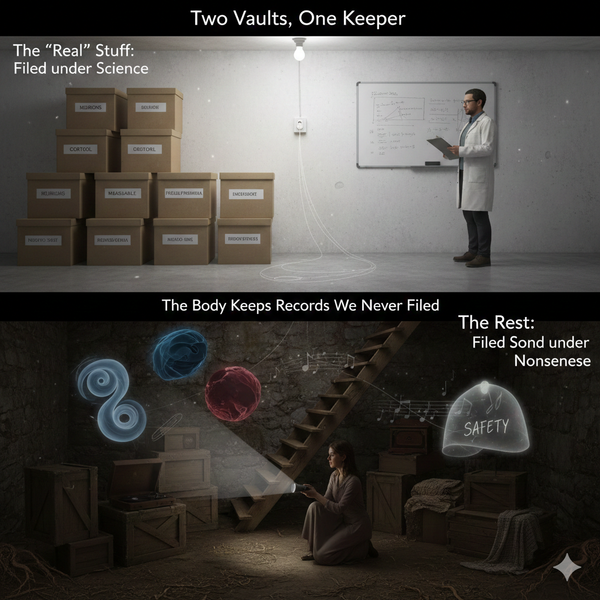
Neuroscientists call this "predictive processing." Your brain doesn't passively record what's happening around you. It makes its best guess based on past experience. It fills in the gaps. It presents you with a coherent story about what's out there.
The problem? That story prioritizes survival over truth.
The world you're experiencing right now (the threats you see, the scarcity you feel, the separation you navigate) might be more constructed than you think.
The Scarcity Filter Runs Your Operating System
Here's what the research shows.
When you're operating from scarcity (financial stress, housing instability, constant survival mode), your brain does something called "tunneling."
Your attention narrows. Your bandwidth shrinks. You focus on immediate threats and lose peripheral vision for everything else.
The studies are clear. Scarcity mindset reduces empathic responses to others' pain. It activates self-centered bias in social decision-making. It makes you less generous in sharing behavior.
This isn't a character flaw.
It's your brain doing what it evolved to do. Protect you when resources feel limited.
Here's the part you need to know: The protection mechanism becomes your perceptual reality.
You start seeing a world confirming the scarcity. Threats everywhere. Competition for limited resources. Everyone out for themselves.
Your emotional state rewrites what you perceive.
People in good moods perceive others' faces as friendlier. Fear activates the amygdala and makes you more likely to see neutral faces as hostile.
You're not seeing what's there. You're seeing what your survival system expects to be there based on your emotional history.
The Kabbalistic Reframe (L'kabel vs. L'hashpia)
Kabbalah has been teaching this for centuries, just in different language.
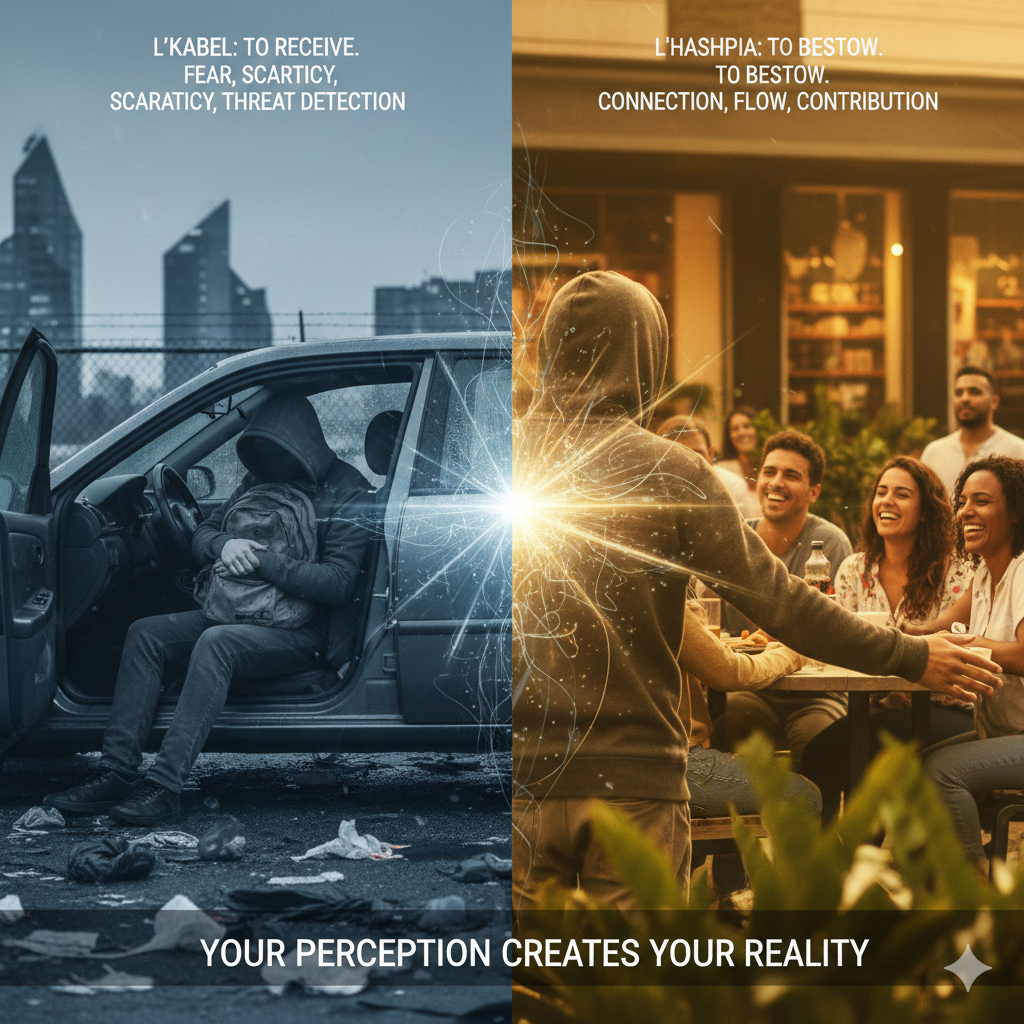
L'kabel means "to receive." It's the orientation of taking in, acquiring, protecting what's yours. The survival stance.
L'hashpia means "to bestow" or "to give." It's the orientation of flowing outward, contributing, connecting.
These aren't moral categories. They're perceptual orientations.
When you operate from l'kabel, you construct a reality where everything is about what you get, what threatens your getting, who's competing for the same resources.
When you operate from l'hashpia, you construct a reality where the organizing principle is contribution, connection, flow.
Same external circumstances. Different perceptual filter. Different experienced reality.
I learned this while housing-insecure. Not as theory. As survival data.
The days I woke up in my car asking "What do I get today?" were the days where every interaction felt like negotiation, every person felt like potential threat or resource, every moment was about protecting what little I had.
The days I woke up asking "What do I give today?" (when I had almost nothing) were the days where people became collaborators, opportunities appeared in peripheral vision, the world felt less hostile.
Same parking lot. Same financial situation. Different operating system.
The Neural Evidence for Generosity as Perceptual Shift
Brain imaging studies reveal something worth noting.
Small acts of generous behavior cause reward-related brain areas to light up with what researchers call a "warm glow."
The amount doesn't matter. Small amounts of generous behavior trigger the warm glow.
More interesting: making a verbal commitment to behave more generously activates altruistic areas of the brain before any action happens.
Your intention to give changes your neural state before you give anything.
Research published in Nature Communications found generous decisions engage the temporo-parietal junction. That's the region involved in empathy and social cognition. These decisions modulate connectivity with the ventral striatum, your reward center.
Translation: To experience happiness from generous behavior, the brain regions involved in empathy need to overwrite selfish motives in your reward system.
You're installing a different perceptual operating system.
One study used transcranial magnetic stimulation to disrupt the prefrontal cortex. That's the region associated with cognitive control. Disrupting it increased generosity.
The implication? Self-protection is the learned override. Generosity is closer to your default setting than you think.
What This Means When You're Barely Surviving
I know what you're thinking.
This sounds great for people with stable housing and full bank accounts. But when you're three days from eviction, choosing between gas money and groceries, when survival is the actual daily question? Telling someone to "be generous" feels like spiritual gaslighting.
I'm not telling you that.
I'm telling you your perception is creating your experience of reality. This perception is heavily weighted toward threat detection when you're in survival mode.
You're living in a world feeling more dangerous, more scarce, more hostile than it is.
The practice isn't about giving away resources you don't have.
The practice is about shifting your perceptual orientation when circumstances haven't changed yet.
This shift changes what you see, what opportunities register, what connections become possible.
The Practice (Two Perceptual Exercises)
Here's what works when you have nothing but attention to redirect.
Exercise One (The Outward Flow Visualization)
Take three breaths. Anywhere. Gas station bathroom, your car, between shifts.
On the inhale, imagine you're drawing in light or energy or whatever word works.
On the exhale, imagine that energy flowing out from your chest in all directions. Not to anyone specific. Just outward.
You're not giving anything material. You're practicing the orientation of outward flow, not inward protection.
Do this for three breaths. That's the practice.
What you're doing: Temporarily interrupting the l'kabel orientation (receiving, protecting, acquiring). Installing the l'hashpia orientation (bestowing, flowing, contributing).
Your brain will start looking for opportunities to give, contribute, connect. This changes what you perceive as possible.
Exercise Two (The Consideration Practice)
Once today, before you interact with someone, pause for two seconds.
Cashier. Coworker. Person on the street. Anyone.
Ask yourself: "What might this person need right now?"
You don't have to give them anything. You don't have to solve their problems. You're practicing the cognitive move of considering their welfare before your transaction.
That's it.
What you're doing: Activating the temporo-parietal junction, your empathy and social cognition region. Training your brain to include others' needs in your perceptual field.
This isn't about being nice. It's about expanding what your attention includes.
When your attention expands, your perceived reality expands.
The Research on Self-Transcendent Experiences
Studies show about a third of the U.S. population agrees they've had an experience where they "felt at one with all things."
During these experiences, your sense of time changes. Your sense of space changes. Your sense of self changes.
Fundamental faculties of consciousness alter.
Research shows self-transcendence is linked to enhanced well-being, increased compassion, empathy, altruism.
You don't need a retreat center or a perfect meditation practice to access this.
You need to interrupt the default perceptual orientation of self-protection long enough for your brain to register connection instead of separation.
This happens in three breaths in a parking lot.
I know because that's where it happened for me.
The Hidden Truth About Your Perception
Your brain evolved to keep you alive in environments where threats were immediate and resources were genuinely scarce.
That system still runs in the background, filtering your perception through threat detection and resource protection.
You're not living in that environment anymore.
Most of the threats your brain highlights aren't life-or-death. Most of the scarcity you feel is constructed by economic systems, not resource limits.
Your perceptual system is responding to a reality that doesn't fully exist.
The shift from l'kabel to l'hashpia (from receiving to bestowing, from protection to contribution) isn't about becoming a better person.
It's about installing a different perceptual filter showing you a different reality.
Connection is possible. Small acts of generosity create neural rewards. Considering others' needs expands what you see.
The world doesn't change first.
Your perception changes. Then the world you experience changes.
What You Do Today
Pick one of the two practices.
The three-breath outward flow visualization. Or the two-second consideration pause before an interaction.
Do it once today.
You're not trying to fix your life, transcend your circumstances, or become enlightened.
You're practicing a different perceptual orientation for three breaths or two seconds.
This is enough to start installing the operating system update.
Your brain will begin looking for evidence supporting this orientation. It will start registering opportunities for connection, contribution, flow. These were always there but filtered out by the threat-detection system.
The reality you experience will shift before your circumstances do.
This isn't magical thinking. This is how perception works.
You're not manifesting abundance. You're expanding what your attention includes.
What your attention includes becomes your experienced reality.
Start there.