The Stuff You Roll Your Eyes At Might Be the Medicine You Need

There is a word that makes "serious" people uncomfortable: Woo.
You know it when you see it. Crystals on windowsills. Talk of "energy" without equations. The coworker who mentions Mercury retrograde when the server crashes. The friend who swears a breathwork session unlocked something her therapist couldn’t touch in three years.
Maybe you’re the person rolling your eyes. Maybe you’re the person being rolled at. Either way, there is something happening beneath the dismissal that deserves our attention.
The Body Keeps Records We Never Filed
Regardless of where you fall on the belief spectrum, we can generally agree on one thing: the body stores experience.
You don't need to believe in chakras to notice that grief lives in the chest. That anxiety coils in the gut. That certain songs make your shoulders drop two inches before your mind registers why. These aren’t metaphors; they are coordinates.
Somewhere along the way, we split human experience into two piles:
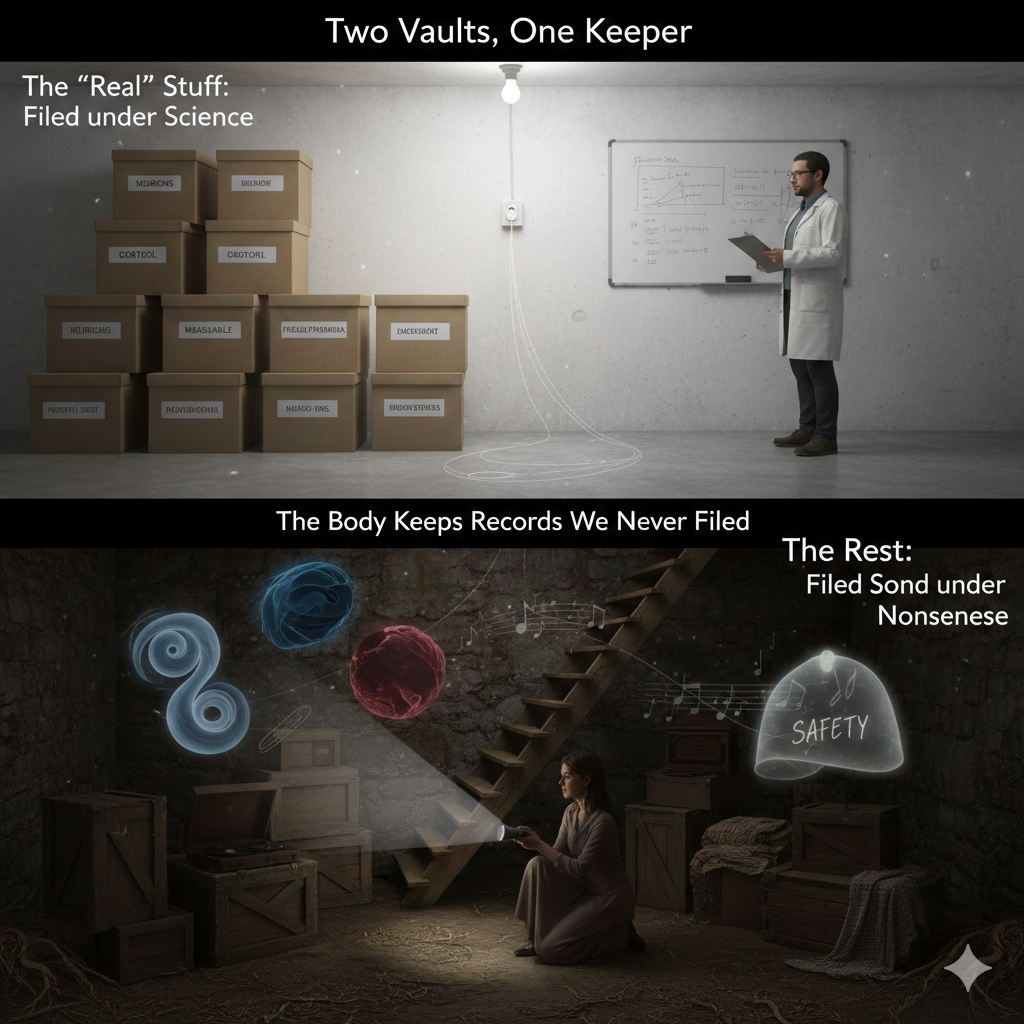
- The "Real" Stuff: Neurons, cortisol, measurable phenomena. Filed under Science.
- The Rest: Intuition, felt sense, the inexplicable "knowing." Filed under Nonsense.
But experience doesn't respect our filing systems. The flinch that happens before you recognize danger, or the way a grandmother’s humming surfaces in your bones forty years later—these are also data. They are simply data we haven't learned to read with the instruments we trust.
Two Vaults, One Keeper
Think of memory as a house with two basements.
The First Basement holds what you can name. The narrative. The sequence of events you could testify to in court. This basement has a light switch, labeled boxes, and an inventory sheet.
The Second Basement has no light switch. It holds what the body absorbed while the mind was busy surviving:
- The texture of the air during your worst year.
- The precise weight of words that were never shouted but landed heavier than fists.
- The shape of safety—or its absence—before you had language to describe it.
Most healing traditions worth their salt know both basements exist. The disagreement is simply about how to access the second one.
This is where "woo" comes in. Not as fantasy, but as a flashlight.
Breathwork, movement, sound, ritual—these practices look strange from the outside but work from the inside. They don't work because they are magic; they work because they speak the rhythmic, tactile language the second basement understands. The body doesn't process in thesis statements.
The Trap of "How" Without "Why"
We live in an age obsessed with mechanism. We want to know how things work, down to the molecular level, before we grant them legitimacy. This impulse gave us antibiotics and airplanes, but it also created a blind spot the size of the human soul.
Some things work long before we understand the "how." Aspirin was used for decades before we understood its biochemistry. Meditation transformed nervous systems for millennia before fMRI machines confirmed it.
Demanding a peer-reviewed mechanism before allowing yourself an experience is a form of intellectual gatekeeping. It says: your healing doesn’t count until a lab validates it. But the nervous system doesn’t wait for publication. The grief still needs somewhere to go.
Grounded, Not Gullible
None of this requires abandoning discernment.
Charlatans exist. Spiritual bypassing—using transcendence as an escape hatch from reality—is real and dangerous. The mystic who can’t pay rent has missed something essential.
But the rationalist who can explain the nervous system in clinical detail, yet remains a stranger to their own felt experience, has also missed the point.
We need both basements. We need the light switch, and we need the willingness to feel our way through the dark.
The Invitation
What if the things you’ve dismissed hold keys you haven't found yet?
I’m not suggesting you abandon reason. I’m suggesting you stop letting reason be the only voice in the room. You don't have to be "woo-woo" to acknowledge that the territory of human healing is wider, stranger, and more generous than any map we’ve drawn so far.
The next time you feel that familiar urge to roll your eyes, try a different question: "What might be happening here that I don’t yet understand?"
A Note From the Basement
I don’t write about the "second basement" or the "unprocessed material of survival" as a theoretical exercise. I write about it as someone who spent more than four years homeless, navigating a world that often refuses to look at what it cannot easily fix.
I am currently in the process of rebuilding—not just a roof over my head, but a life. My goal is to transform the "data" I gathered in those years into a platform for advocacy and a non-profit dedicated to those still caught in the cycle of homelessness and hopelessness.
I believe that solving these issues requires more than just policy; it requires the same curiosity and "language of the body" I wrote about above. It requires seeing the person, not just the problem.
If this essay resonated with you, I invite you to join me in this rebuilding.
Your support helps me stay on this path of advocacy and ensures I can keep sharing these insights as I work toward building a more compassionate system for us all.
- Fuel the journey:Buy Me a Coffee
- Share the work: If you know someone who needs to hear this today, please forward this post.
The map is not the territory. And with your help, I’m learning to draw a much better map.